Bites of Compose 6
What is Modifier after all?

In previous post we talked about the companion object Modifier and how it’s implementing the interface Modifier.
Now it is time to go deeper and see Modifier’s internals.
Situation 1
What is Modifier after all?
Answer
Well, what if I tell you Modifier is just a binary tree data structure.
Let’s dive into the source code to prove this.
First let’s take a look at the class hierachy, we have 3 pieces: Modifier(interface), Element and CombinedModifier.
Element is like a leaf node.
CombinedModifier is like a parent node that contains two children nodes: left(outer) and right(inner).
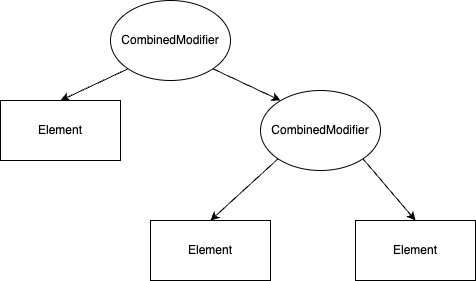
The code below is take straight from the Modifier source code, and I put in some contrived usecases to help you understand things better.
fun main(args: Array<String>) {
    // outer ----------> inner
    //val mod = MyModifier(1) then MyModifier(2) then MyModifier(3)
    val mod = CombinedModifier(MyModifier(1), CombinedModifier(MyModifier(2), MyModifier(3)))
    println(mod)
    println("------------------------")

    val allLessThanFive = mod.all { e ->
        val n = (e as MyModifier).n
        n < 5
    }
    println("All less than 5? $allLessThanFive")
    println("------------------------")

    val anyBiggerThanFour = mod.any { e ->
        val n = (e as MyModifier).n
        n > 4
    }
    println("Any bigger than 4? $anyBiggerThanFour")
    println("------------------------")

    val sum = mod.foldIn(0) { acc, e ->
        val n = (e as MyModifier).n
        println("...adding $n")
        acc + n
    }
    println("Sum is $sum")
    println("------------------------")

    val sum2 = mod.foldOut(0) { e, acc ->
        val n = (e as MyModifier).n
        println("...adding $n")
        acc + n
    }
    println("Sum is $sum2")

}

interface Modifier {

    fun <R> foldIn(initial: R, operation: (R, Element) -> R): R

    fun <R> foldOut(initial: R, operation: (Element, R) -> R): R

    fun any(predicate: (Element) -> Boolean): Boolean

    fun all(predicate: (Element) -> Boolean): Boolean

    infix fun then(other: Modifier): Modifier =
        if (other === Modifier) this else CombinedModifier(this, other)

    interface Element : Modifier {
        override fun <R> foldIn(initial: R, operation: (R, Element) -> R): R =
            operation(initial, this)

        override fun <R> foldOut(initial: R, operation: (Element, R) -> R): R =
            operation(this, initial)

        override fun any(predicate: (Element) -> Boolean): Boolean = predicate(this)

        override fun all(predicate: (Element) -> Boolean): Boolean = predicate(this)
    }

    companion object : Modifier {
        override fun <R> foldIn(initial: R, operation: (R, Element) -> R): R = initial
        override fun <R> foldOut(initial: R, operation: (Element, R) -> R): R = initial
        override fun any(predicate: (Element) -> Boolean): Boolean = false
        override fun all(predicate: (Element) -> Boolean): Boolean = true
        override infix fun then(other: Modifier): Modifier = other
        override fun toString() = "Modifier"
    }
}

class CombinedModifier(
    private val outer: Modifier,
    private val inner: Modifier
) : Modifier {
    override fun <R> foldIn(initial: R, operation: (R, Modifier.Element) -> R): R =
        inner.foldIn(outer.foldIn(initial, operation), operation)

    override fun <R> foldOut(initial: R, operation: (Modifier.Element, R) -> R): R =
        outer.foldOut(inner.foldOut(initial, operation), operation)

    override fun any(predicate: (Modifier.Element) -> Boolean): Boolean =
        outer.any(predicate) || inner.any(predicate)

    override fun all(predicate: (Modifier.Element) -> Boolean): Boolean =
        outer.all(predicate) && inner.all(predicate)

    override fun toString() = "[" + foldIn("") { acc, element ->
        if (acc.isEmpty()) element.toString() else "$acc, $element"
    } + "]"
}

class MyModifier(val n: Int) : Modifier.Element
And here is the result of running the code above:
[MyModifier@1a407d53, MyModifier@3d8c7aca, MyModifier@5ebec15]
------------------------
All less than 5? true
------------------------
Any bigger than 4? false
------------------------
...adding 1
...adding 2
...adding 3
Sum is 6
------------------------
...adding 3
...adding 2
...adding 1
Sum is 6
Share this post
Twitter
Google+
Facebook
Reddit
LinkedIn
StumbleUpon
Email